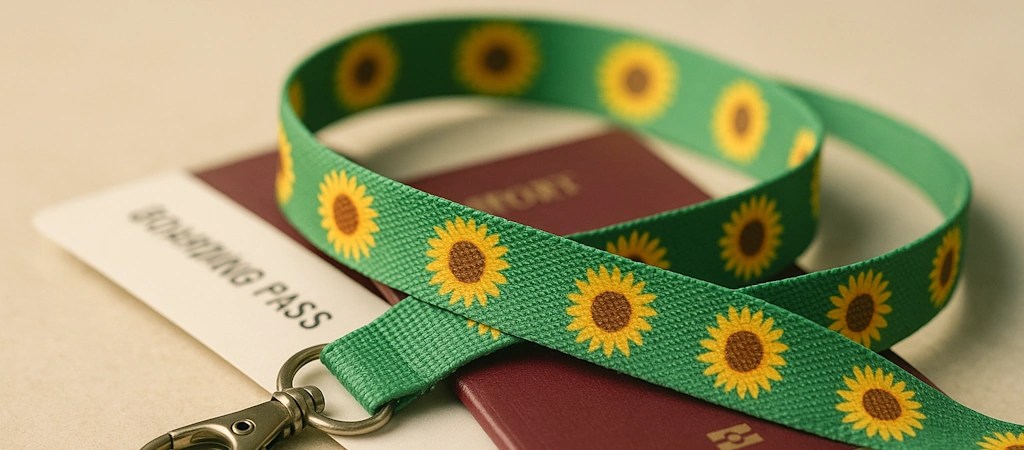
Perhaps first a few words about the Sunflower Lanyard.
The purpose of the Sunflower Lanyard is to make invisible disabilities visible. Not all limitations people face in society are immediately apparent, like someone in a wheelchair. Initially, the lanyard was designed to help travellers at Gatwick Airport. Airports, with their unique procedures and processes, can be challenging even for healthy travellers. For people with disabilities of any kind, airports often remain a place of constant stress.
Railway stations are just as stressful as other busy places. However, like my experiences at airports, I notice a clear difference between railway stations in mainland Europe and those in the United Kingdom. In Germany and other countries on the continent, the common belief is that technology can fix all problems. As long as there are enough escalators and elevators, people with disabilities can manage without additional help. This reveals a shortsighted view of inclusive accessibility. As I have explained, not all disabilities are visible, and not all can be fixed with technology. People need others to help them handle the stress that naturally occurs in special (travel) situations.
Since my cancer diagnosis, I have worn a Sunflower Lanyard when I travel. My experiences with it have been quite mixed.
The two airports I most often use in Germany are Berlin and Düsseldorf. Both airports participate in the Sunflower program and aim to make travel more comfortable for people with invisible disabilities. Over the past eighteen months, I’ve seen that the Sunflower program is mostly just a mention on the airports’ websites or social media. Providing considerate and helpful service requires trained staff. Here, the service issue is as apparent as an open fracture. From check-in and security to boarding, you meet staff who don’t know what the Sunflower lanyard means or what it says about the wearer. The employees are not to blame; no one has trained them. The staff shortage and cost-cutting outsourcing leave little room for respectful treatment of travellers. The term “service desert” (German: “Servicewüste”) reflects a tragic reality, showing that people with disabilities – visible or invisible – are viewed as a burden in Germany.
Interestingly, my experiences with the Sunflower Lanyard in the UK, Scandinavia, and even the US vary greatly. I don’t want to fall into the trap of overpraising here. The care and the fact that staff ask me if I need help or support touch me deeply every time.
One airport and one airline always stand out for me: Heathrow Airport, especially Terminal 5, and British Airways. Boarding a flight can be a particular challenge that causes significant stress for people with disabilities. Unfortunately, some travellers lose their manners when boarding, depending on their type. The boarding areas for each gate at Terminal 5 are spacious. Pre-boarding can be handled efficiently here, thanks to a waiting area with ample space behind the gate counters.
This is a significant difference compared to airports in Germany. Here, pre-boarding is also common but often involves passengers standing in the jet bridge while the aircraft itself is not yet ready for boarding. Gate staff conduct this type of boarding mainly to meet official boarding times for statistical purposes, completely disregarding passengers’ needs.
I don’t just wear my Sunflower Lanyard at travel destinations that participate in the Sunflower Lanyard program. The lanyard can also serve as a conversation starter. During a domestic flight in Germany, a flight attendant approached me about it. She had noticed the lanyard several times before but didn’t know what it signified. We had an interesting conversation where I explained the purpose of the Sunflower Lanyard campaign.
I invite you to check out the Sunflower website and promote it in your work environment. Because it’s not just about travel, it’s about much more than that.
We are all just a blink of an eye away from a stroke of fate that can change a life forever.
Edited with Grammmary

Leave a comment